The Domain Name System (DNS) is often described as the internet’s “phonebook.” It converts familiar domain names into the IP addresses computers use to communicate. When DNS is compromised or manipulated, users can be redirected to malicious websites without any visible warning.
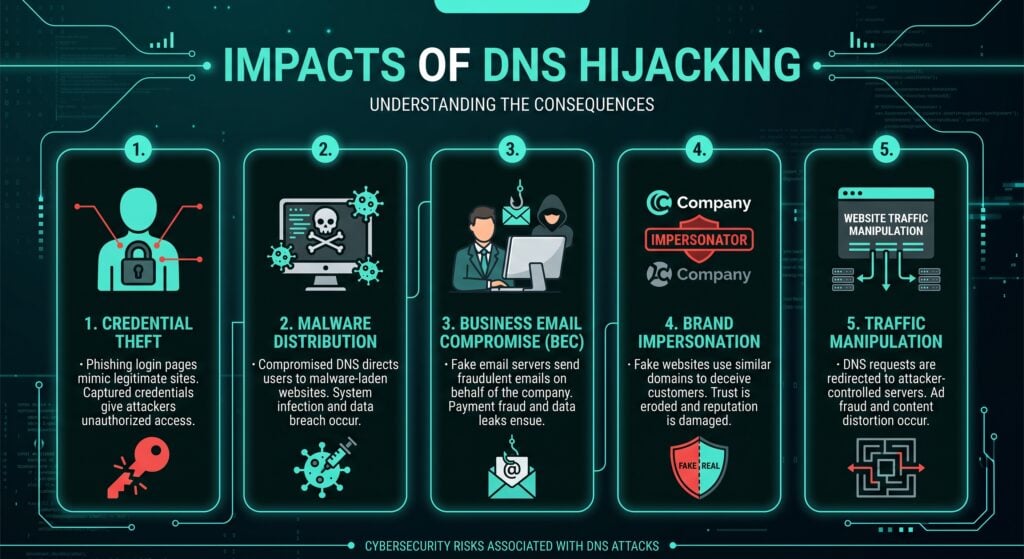
For businesses, the impact can range from minor disruption to serious consequences – including stolen login credentials, malware infections, reputational harm, and even regulatory scrutiny.
And it’s not always about direct credential theft, performed at scale from far-eastern fraud-farms. Hijacked domains and forgotten subdomains can be repurposed to host large-scale spam operations – from rogue online pharmacies to unregulated gambling platforms and other high-margin industries seeking traffic without legitimate marketing overheads. In these cases, your domain becomes the vehicle for someone else’s profit – and your brand absorbs the risk.
But What Exactly Is DNS Hijacking?
DNS hijacking is a cyberattack in which a malicious actor alters DNS resolution to redirect users to unintended or fraudulent websites. In simple terms:
Instead of taking you to the real website, DNS takes you somewhere else – on purpose.
In a DNS hijack, that IP address is replaced with one controlled by an attacker. OR the IP address is spoofed, which can occur when redundant DNS records are left in place – an invitation for a DNS hijacker to exploit.
DNS hijacking is sometimes referred to as:
- DNS redirection
- DNS poisoning (when cache manipulation is involved)
While the terms are related, the key idea is the same: the DNS answer has been tampered with.
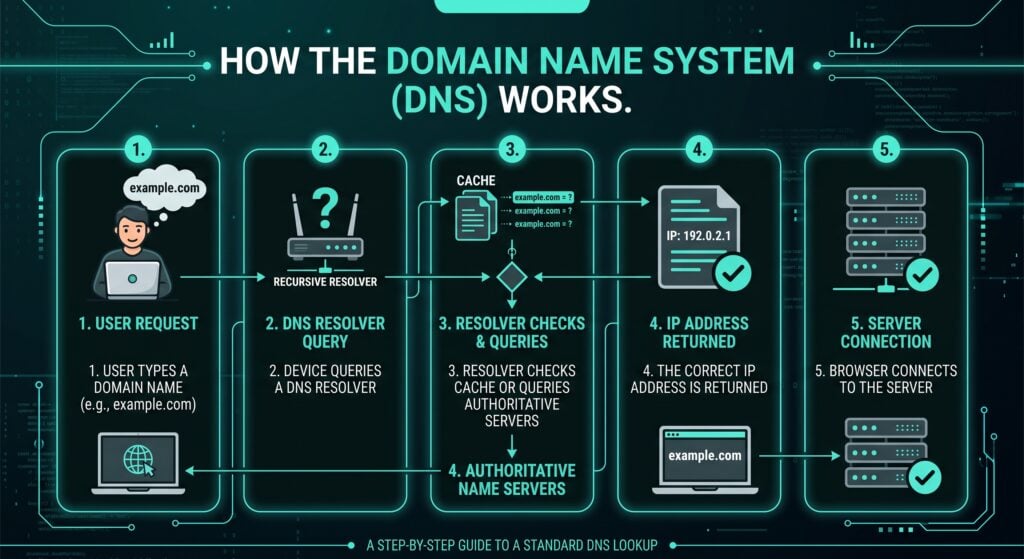
How DNS Works
To understand DNS hijacking, you need a quick overview of how DNS functions.
- You type a domain name (e.g. example.com).
- Your device queries a DNS resolver.
- The resolver checks its cache or queries authoritative name servers.
- The correct IP address is returned.
- Your browser connects to that server.
If an attacker interferes at any point in this chain – whether at the device, router, resolver, or domain registrar level – traffic can be redirected. DNS sits at the foundation of internet communication. If it’s compromised, everything built on top of it is vulnerable.
Types of DNS Hijacking
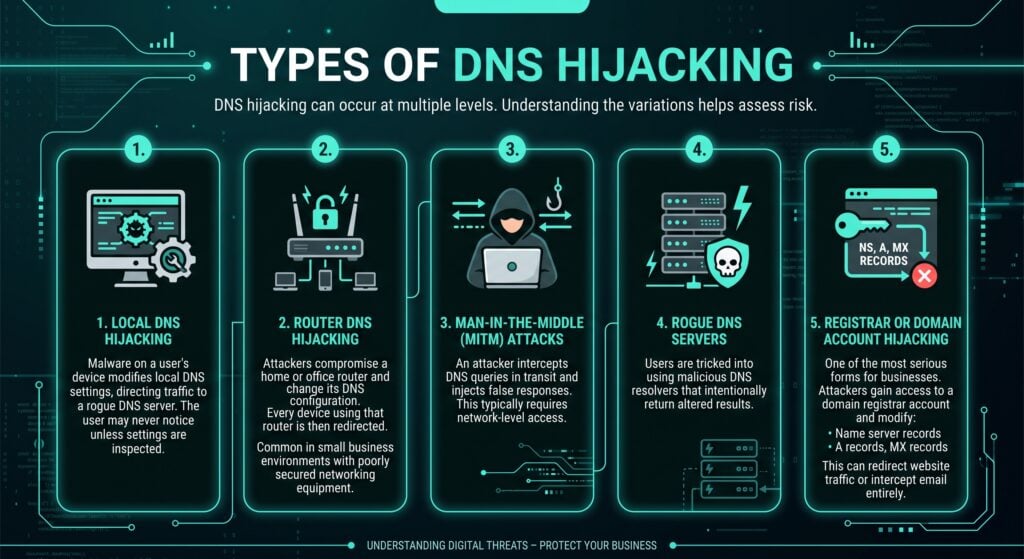
DNS hijacking can occur at multiple levels, and understanding the variations helps assess risk.
At the local level, malware on a user’s device can modify DNS settings and direct traffic to a rogue server, often without the user ever noticing. Attackers can also compromise a home or office router and change its DNS configuration, redirecting every device on the network, a tactic particularly common in small businesses with poorly secured equipment.
In man-in-the-middle attacks, which typically require network-level access, an attacker intercepts DNS queries in transit and injects false responses, while in other cases users are simply tricked into using rogue DNS resolvers that intentionally return altered results.
The most serious form for businesses is registrar or domain account hijacking, where attackers gain access to a domain registrar account and modify name server, A, or MX records, allowing them to redirect website traffic or intercept email entirely.
DNS Hijacking vs DNS Cache Poisoning
DNS hijacking refers to the broader outcome: users are redirected from legitimate websites to malicious or unintended destinations. This can occur through compromised routers, altered registrar settings, rogue DNS servers, or malware on endpoints.
DNS cache poisoning, by contrast, is a specific technique used to enable that redirection. It involves injecting false DNS records into a resolver’s cache, causing future users to receive incorrect IP addresses without realising it. Put simply:
Cache poisoning is one method; hijacking is the result.
From a business perspective, the technical distinction matters less than the impact. Whether through cache manipulation or account compromise, the consequence is the same – traffic goes somewhere it shouldn’t, exposing organisations to credential theft, malware distribution, and reputational damage.
Why DNS Hijacking Is Dangerous
DNS hijacking isn’t just a technical nuisance – it’s a strategic attack that targets one of the most fundamental layers of internet trust. Because DNS sits at the core of how users reach websites and services, manipulating it allows attackers to redirect traffic silently and at scale. Unlike obvious phishing emails or visible malware infections, DNS hijacking often happens behind the scenes, making it harder to detect and easier to exploit. When the infrastructure that directs your traffic is compromised, every system that relies on it – websites, email, cloud platforms – is suddenly at risk.
Signs You May Be a Victim
DNS hijacking can be difficult to detect because it often operates silently in the background, going unnoticed – and in some cases where forgotten subdomains are concerned, they can exist for months without detection. Users may continue browsing as normal, unaware that traffic is being redirected or intercepted. However, there are warning signs that suggest your DNS settings, infrastructure, or domain records may have been compromised. Recognising these indicators early can significantly reduce the impact of an attack and prevent further damage.
Indicators of DNS hijacking include:
- Unexpected redirects to unfamiliar websites
- SSL certificate warnings
- Login pages that look slightly different
- Sudden changes in DNS settings
- Customers reporting strange behaviour accessing your site
- Domain records modified without authorisation
Early detection is critical. The longer hijacking persists, the greater the damage.
How to Prevent DNS Hijacking
Many organisations only discover DNS hijacking after customers report strange redirects or login failures. The reality is that DNS is rarely monitored as closely as firewalls or endpoints. Compromises can go unnoticed for weeks or even months. If you’re not actively looking for DNS manipulation, you’re unlikely to spot it.
Preventing DNS hijacking requires a layered approach. Because DNS sits at the foundation of internet communication, security must combine both technical safeguards and organisational controls to reduce risk and detect tampering early.
Technical Measures
- Enable DNSSEC (Domain Name System Security Extensions) to verify DNS responses
- Use multi-factor authentication (MFA) for domain registrar accounts
- Apply registrar lock / domain lock
- Restrict and monitor DNS record changes
- Secure routers and networking equipment
- Deploy endpoint protection on user devices
Organisational Controls
- Limit administrative access to DNS systems
- Implement strong password policies
- Conduct regular DNS audits
- Remove old or redundant DNS records
- Provide cyber awareness training to staff
For UK organisations, aligning DNS security practices with guidance from the National Cyber Security Centre (NCSC) strengthens overall resilience.
DNS Hijacking vs Other Attacks
It’s helpful to distinguish DNS hijacking from similar threats:
- Phishing: Tricks users via deceptive emails; DNS hijacking manipulates infrastructure.
- Domain spoofing: Creates lookalike domains; hijacking redirects legitimate ones.
- BGP hijacking: Redirects traffic at the internet routing level, not the DNS level.
DNS hijacking is uniquely dangerous because it manipulates trusted infrastructure rather than relying solely on user deception.
Conclusion: Protect the Foundations
DNS is one of the most critical – and most overlooked – components of cybersecurity, and a DNS hijack exploits the infrastructure users inherently trust.
Protecting DNS through strong access controls, DNSSEC, monitoring, and account security is not optional – it’s foundational. If you’re unsure whether your DNS infrastructure is properly secured, now is the time to review it – before someone else does.
If you’re concerned about DNS security, get in touch with us today to discuss how best to protect and secure your infrastructure.
Frequently Asked Questions
DNS hijacking is a cyberattack where a malicious actor redirects DNS queries to a fraudulent IP address, sending users to fake or malicious websites instead of the legitimate destination. It manipulates the internet’s “address book” to reroute traffic without the user’s knowledge.
A DNS attack is any malicious activity targeting the Domain Name System. This includes DNS hijacking, DNS cache poisoning, DNS tunnelling, and DNS amplification attacks. These attacks aim to redirect traffic, steal data, disrupt services, or bypass security controls.
DNS attacks are increasingly common because DNS is foundational to internet traffic. Attackers target DNS because it is often less monitored than firewalls or endpoints. Large-scale DNS incidents have affected enterprises, ISPs, and even global platforms in recent years.
One of the most common DNS-related attacks is DNS cache poisoning, where false DNS records are inserted into a resolver’s cache, redirecting users to malicious sites. DNS hijacking via compromised routers or registrar accounts is also common in business environments.